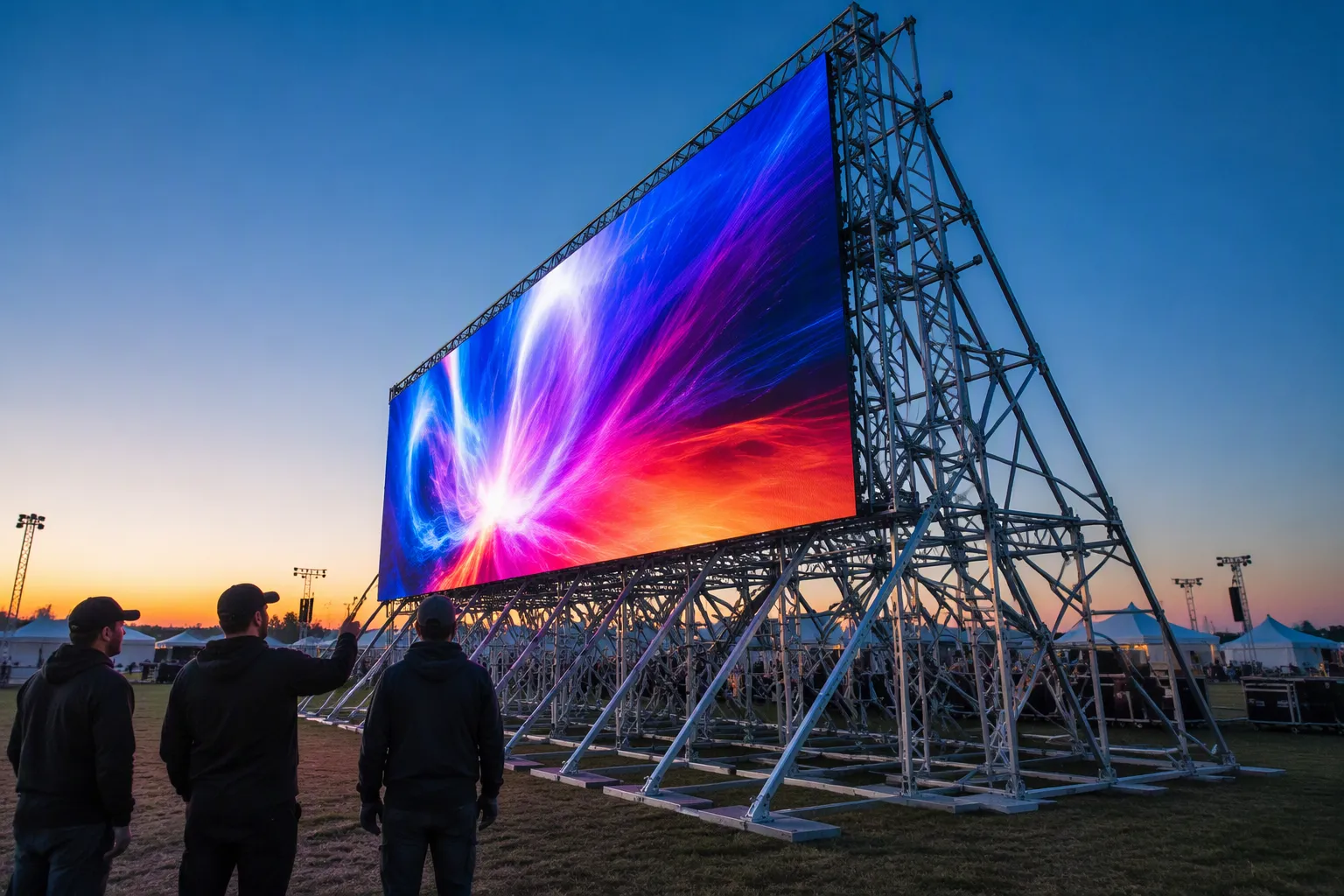
GF-Truss built the 40m LED wall ground support with a modular truss system. Base plates, vertical and horizontal trusses, and adjustable brackets guarantee stability and safety. This LED wall support project supports a 40-meter-wide screen weighing 12,800 kilograms. You need engineered load distribution and wind resistance at that scale. You get a modular, mobile, and scalable system for touring and one-off large productions.
Key Takeaways
What Is LED Wall Ground Support?
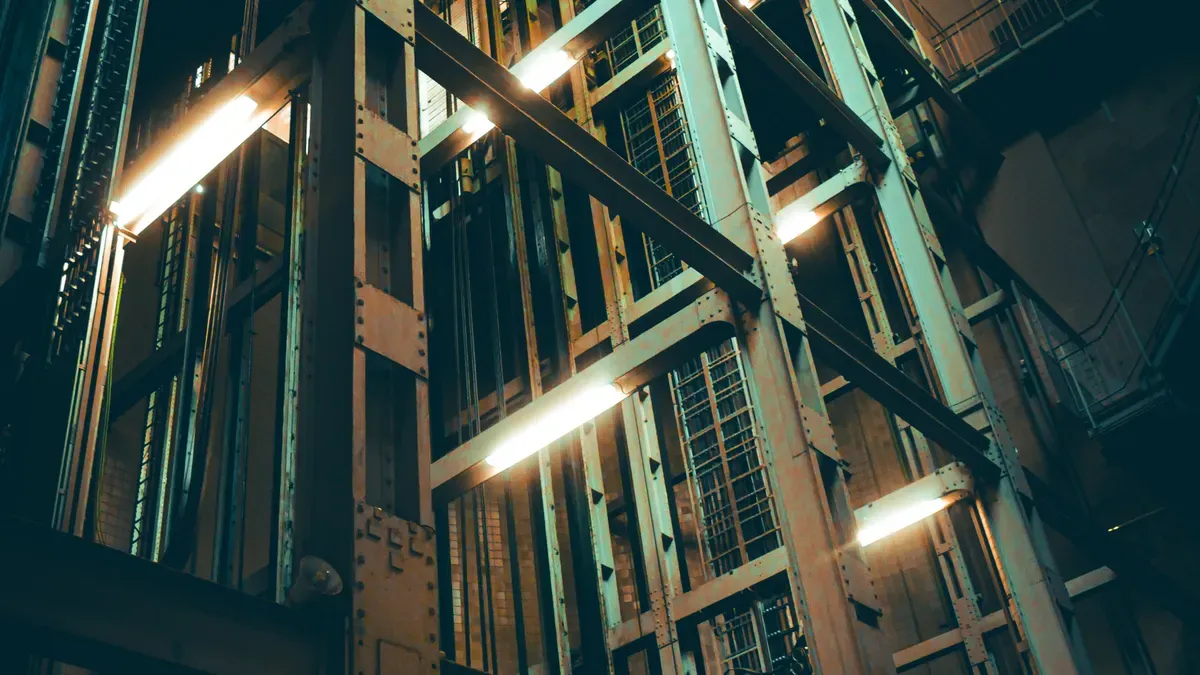
LED wall ground support is a self-standing framework that holds LED video panels upright from the ground. You do not hang the screen from a ceiling or rigging point. Instead, the structure carries the full weight of the wall and keeps every panel aligned. A modular truss system makes this possible. GF-Truss designs these systems around a set of core components, and each part has a clear job.
| Component | Function / Specification |
|---|---|
| Heavy-duty base plates | Provide foundation and stability for the self-standing tower; manage front-heavy LED loads |
| Outriggers and rear-stabilizing towers | Maintain center of gravity at height; resist wind load; require ballast and locking verification |
| Sleeve blocks | Enable mechanical height adjustment of the tower |
| Top sections | Form the upper connection structure of the ground support tower |
| LED mounting bars | Modular sections designed to mount LED video wall cabinets |
| Screw-jack leveling feet | High-precision alignment on uneven terrain for seamless LED wall seams |
| T6-6082 structural aluminum | Corrosion-resistant, lightweight material offering 500kg+ load capacity per tower |
| Universal connection plate | Mounts LED panels to 50mm tube for ground stack or ceiling installation |
Ground-supported installation suits outdoor events, concerts, trade shows, and temporary setups. You stack LED panels on the ground within a specially designed framework. Safety is non-negotiable in rigging. You must plan load distribution carefully to prevent overloading at any single point. You should also plan the wall's footprint in advance to catch problem areas. Supports must stay level so panels lock together seamlessly. Clear communication and coordination among all parties keep the rigging process smooth and safe.
Ground support systems keep large LED walls secure and upright even in challenging conditions. Wind and other environmental factors create real risk outdoors. Heavy-duty base plates provide a solid foundation, distribute the wall's weight, and prevent tipping or shifting. Safety cables, tensioning straps, and other rigging components secure the LED wall and prevent accidents or collapses.
Inside the 40m LED Wall Support Project
GF-Truss approaches every large-scale LED wall support project with engineering discipline. The 40m LED wall ground support structure demonstrates what modular truss design can achieve under real-world demands. You face a 40-meter-wide screen. The total screen weight reaches 12,800 kilograms. These numbers demand more than standard equipment. They demand a system built around load distribution, wind resistance, and structural integrity.
The LED wall support project required careful planning from the first sketch. GF-Truss engineers calculated point loads across every base plate. They modeled wind forces against the full surface area of the wall. They verified every connection point against safety thresholds. The result is a proven framework that touring crews and production teams can trust. You get a system that performs under pressure, show after show.
Base plates form the foundation of the entire structure. GF-Truss uses heavy-duty steel base plates that distribute the wall's weight across a wide footprint. You need this distribution because a 12,800-kilogram screen creates enormous downward force. Concentrated loads at a single point would compromise stability. Wide base plates spread that force safely into the ground.
Outriggers extend from the main towers to widen the support base further. Rear-stabilizing towers counterbalance the front-heavy LED load. You must secure ballast weight and verify all locking mechanisms before the wall goes up. Screw-jack leveling feet allow precise height adjustment on uneven terrain. This precision matters because LED panels must align perfectly. Even a small height difference creates visible seams across the screen. GF-Truss base plates and leveling feet solve this problem before it starts.
Vertical trusses carry the primary compressive loads from the LED wall down to the base plates. GF-Truss builds these towers from T6-6082 structural aluminum. This material offers corrosion resistance and high strength at a manageable weight. Each tower handles 500 kilograms or more of load capacity. Sleeve blocks inside the vertical trusses enable mechanical height adjustment. You can raise or lower sections to match venue requirements.
Horizontal trusses connect the vertical towers and create a rigid framework. They resist lateral forces from wind and prevent the structure from swaying. The horizontal truss sections also provide mounting points for LED panels. GF-Truss designs every truss segment for quick assembly and disassembly. Universal connection plates mount LED panels to 50mm tubes for ground stack or ceiling installation. This modular approach keeps the system flexible across different stage layouts.
Adjustable brackets connect the LED panels to the truss framework. These brackets give you fine control over panel position and alignment. The right bracket system makes the difference between a seamless screen and a visible grid of misaligned panels. GF-Truss integrates bracket solutions that match the demands of large LED walls.
| Attribute | Specification |
|---|---|
| Bracket type | LED screen mounting bracket with integrated truss clamp |
| Adjustability | Telescoping arm extending from 9" to 12" |
| Truss clamp compatibility | F32, F34, and 12-inch bolt truss segments |
| Load capacity | Up to 250 kg (550 lbs) |
| Intended use | LED panel/screen mounting for live events, stage setups, and installations |
| Brand | AUVI |
The telescoping arm extends from 9 to 12 inches. You gain flexibility in panel depth and positioning. The integrated truss clamp fits F32, F34, and 12-inch bolt truss segments. Each bracket supports up to 250 kilograms. This load capacity gives you confidence when mounting large LED cabinets at height. The bracket system works with the truss framework to keep every panel secure and aligned throughout the event.
GF-Truss designs ground support systems for real-world production conditions. Versatility comes from the modular truss components. You can configure the system for different screen widths and heights. Mobility matters for touring productions. The aluminum truss sections break down into manageable pieces. Crews transport and reassemble the structure quickly between venues. Scalability allows you to expand the system as screen sizes grow. You add truss bays and base plates to extend the wall without redesigning the entire framework.
Safety standards guide every design decision. OSHA hoisting and rigging standard 1926.753 applies to ground-stacked LED walls. GF-Truss targets a locking system safety factor of SF10 or better. This factor means the component can theoretically hold ten times its rated load. You must also satisfy venue-specific requirements alongside OSHA standards. Outdoor festival conditions introduce wind, uneven ground, and longer show durations. These conditions may require lower stacks, additional bracing, or flying the wall from a truss. GF-Truss helps you evaluate these factors for every LED wall support project.
| Safety Standard / Criterion | Requirement / Description |
|---|---|
| OSHA hoisting and rigging standard (1926.753) | Referenced as the applicable federal standard for hoisting and rigging of ground-stacked LED walls |
| Locking system safety factor | Ideally SF10 or better; must match OSHA and venue requirements for the application |
| Safety factor definition | Ratio of load a component can withstand before failure to the load it carries in normal use; SF10 means it can theoretically hold ten times its rated load |
| Venue-specific requirements | Venue's own requirements must also be satisfied alongside OSHA standards |
| Outdoor festival conditions | Wind, uneven ground, and longer show durations require lower stacks, additional bracing, or flying from a truss |
Ground support systems serve a wide range of large-event applications. You see them at outdoor concerts and music festivals where stages lack overhead rigging points. Trade shows and exhibitions use ground support for large LED displays in convention centers. Corporate events and product launches rely on these structures for impactful visual presentations. Sports venues and broadcast productions use ground-supported LED walls for replay screens and sponsor displays. Temporary installations at public events benefit from the system's mobility and quick setup.
GF-Truss ground support systems adapt to each of these environments. The modular design means you configure the same core components for different screen sizes and venue constraints. A touring concert production might use a 40m wall with full ballast and outrigger support. A trade show display might use a smaller configuration with the same base plates and truss sections. This flexibility makes the system practical for both repeat touring and one-off large productions. You invest in one framework that serves many applications.
Step-by-Step Installation Process
You need a clear installation sequence to build a 40m LED wall ground support structure safely. GF-Truss designs every component for fast assembly and predictable results. The process below walks you through each stage of the LED wall support project, from site preparation to final verification.
You start with the ground. Walk the site and confirm the surface is level and stable. Mark the footprint of the LED wall on the ground using the engineering drawings. Check the total width against the 40-meter screen specification. Verify that the base plate positions match the truss tower spacing. Measure the distance between tower centers and confirm it matches the design.
Inspect the ground for soft spots, slopes, or drainage issues. Screw-jack leveling feet can correct minor height differences. Major slopes require shoring or a different base configuration. Confirm that ballast materials are on site before assembly begins. You need ballast on every base unit, and the amount depends on screen height and weight. A 2.00 m stack might need 25 lbs per base. A 4.00 m stack might need 150 lbs per base. Plan the ballast delivery and placement in advance.
Check overhead clearance and underground utilities. Ground support systems are self-standing, but you still need space for outriggers and rear-stabilizing towers. Mark safety zones around the structure. Keep unauthorized personnel away from the assembly area during installation.
GF-Truss uses a modular ground support system where all parts connect with quick locks. This design enables easy and convenient installation. A crew of only 2 to 3 people can assemble the system. Follow these steps for base and tower assembly:
1. Position each T-base at the marked location. The T-base is a heavy-duty steel foundation for ground-stacked LED walls. Its center-mounted truss interface provides a balanced load path from the vertical truss to the floor.
2. Level each base using the three height-adjustable leveling feet. These feet allow precise leveling on uneven surfaces. You can remove the feet to bolt the base directly to the floor for permanent or semi-permanent installs.
3. Link multiple T-bases mechanically to support extended LED wall widths. This scalability lets you build the full 40m span without custom fabrication.
4. Insert the vertical F32 I-Beam truss segment into the base. Hardware comes included. The base also accepts a 12-inch bolted I-Beam truss or F34 and 12" box truss configurations.
5. Add ballast to every base unit. Ballast weight depends on screen height and weight. For larger setups, add extra weights during setup. You can also use extra ladder trusses and enlarged bases with water tanks at the base to improve wind resistance and prevent forward tipping.
6. Attach telescoping LED wall panel pole clamps to the base for accurate panel positioning and secure attachment. These clamps are sold separately.
7. Repeat this process for each tower position across the 40m span.
The T-base disassembles quickly by removing two locking pins. This feature keeps storage and transport compact between venues.
You build the horizontal framework after the vertical towers stand secure. Connect horizontal truss sections between the vertical towers. GF-Truss uses T6-6082 structural aluminum for all truss segments. This material offers corrosion resistance and high strength at a manageable weight. Each tower handles 500 kilograms or more of load capacity.
Use sleeve blocks inside the vertical trusses to adjust height mechanically. Raise or lower sections to match the venue requirements. Verify that every horizontal truss sits level before you tighten connections. A level framework prevents panel misalignment across the screen.
Mount the LED panels using adjustable brackets. The telescoping arm extends from 9 to 12 inches for flexible panel depth and positioning. The integrated truss clamp fits F32, F34, and 12-inch bolt truss segments. Each bracket supports up to 250 kilograms. Work from the center of the wall outward. This sequence keeps the load balanced as panels go up. Check each panel connection before moving to the next one. Confirm that universal connection plates mount securely to the 50mm tube.
Safety verification protects your crew and your audience. Run through every check before the system goes live. Start with bolt torque. Use a calibrated torque wrench for all connections.
| Check | Specification / Recommendation |
|---|---|
| Bolt torque (M8) | 8–10 Nm (5.9–7.4 lb-ft) |
| Bolt torque (M10) | 12–15 Nm (8.9–11 lb-ft) |
| Overtightening risk | Above 10–12 Nm can strip threads or crack aluminum frames |
| Undertightening risk | Below 8 Nm allows vibration loosening over time |
| Torque re-check interval | Every 3–6 months (vibration can reduce torque 15–20% within a year) |
| Tool | Calibrated torque wrench |
After torque checks, verify the electrical system. Follow this sequence:
1. Pre-power inspection — Use a multimeter to verify input voltage at each power supply reads 110–120V or 220–240V (±10%), with fluctuation not exceeding ±5%.
2. Individual panel power-on — Power each panel separately for 10–15 minutes before linking them.
3. Dead pixel check — Acceptable threshold is fewer than 3–5 dead pixels per m². Replace any panel that exceeds this threshold.
4. Color consistency check — Use a colorimeter to confirm white balance of 6500K ±200K and color deviation Delta E <3.0 between panels. Delta E >5.0 is visibly noticeable.
5. Brightness variance check — Panels should not differ by more than 10% in brightness to avoid patchy visuals.
Finish with a structural safety walkthrough. Confirm that LED panels are level and securely connected. Check that no movement or displacement has occurred. Verify that all safety locking devices are functioning. For long-term or frequently disassembled installations, establish regular inspection and maintenance plans. Focus on the base support structure, connectors, and high-stress parts. Tighten, adjust, or replace worn components promptly. Before each relocation or repeated installation, re-level the structure and inspect it. This practice reduces fatigue risk and ensures continued safe operation.
GF-Truss combined modular truss design, engineered base plates, and adjustable brackets to deliver a safe, scalable 40m LED wall support structure. You gain fast installation, mobility, scalability, and reliable safety for large events. Contact GF-Truss today for custom ground support solutions and expert consultation on your next LED wall support project.
FAQ
How much weight can a 40m LED wall ground support structure hold?
A 40m GF-Truss system supports a 12,800-kilogram screen. Each tower handles 500 kilograms or more. Engineered base plates distribute the total load safely across the full footprint.
How many people does it take to install an LED wall ground support system?
A crew of 2 to 3 people can assemble the GF-Truss modular system. Quick-lock connections and included hardware speed up installation. You save labor time on every setup.
What safety factor should you target for LED wall ground support?
Target a locking system safety factor of SF10 or better. This factor means each component can theoretically hold ten times its rated load. Always meet OSHA and venue requirements.


 IPv6 RÉSEAU PRIS EN CHARGE
Laisser un message
Numériser vers WhatsApp :

Hi! Click one of our members below to chat on
 Tél
:
 E-mail
:
 Français
 English
 Pусский
 Español
 العربية